A polarised Egypt is facing the most critical phase of its post-revolutionary life after Egypt's army ousted the country's elected president, Mohamed Morsi, and scheduled fresh elections in a what was labelled by the presidency as a "full coup".
The chief of the armed forces, General Abdel-Fatah al-Sisi, announced that he had suspended the constitution and would nominate the head of the constitutional court, Adli Mansour, as interim president on Thursday. Both presidential and parliamentary elections would follow shortly afterwards and a transitional cabinet would be named.
In the early evening, a presidential aide told the Guardian Morsi was still free, but late on Wednesday night a Muslim Brotherhood spokesman said Morsi was being held by the authorities in an unknown location.
A security official said the head of the Muslim Brotherhood's political party and the Brotherhood's deputy chief had been arrested. State media said authorities had issued arrest warrants for 300 other Brotherhood members.
At least 14 people were killed when Morsi opponents and supporters clashed after the army's announcment, state media and officials said. Eight of those reported dead were in the northern city of Marsa Matrouh Three people were killed and at least 50 wounded in Alexandria, state news agency MENA reported. A further three died in the southern city of Minya, it said.
Sisi strove to paint the coup as the fulfilment of the popular will, following days of vast protests against Morsi's rule.
"We will build an Egyptian society that is strong and stable, that will not exclude any one of its sons," he said.
He spoke of his "historic responsibility" in front of a panel of Egyptians representing what was intended to be full spectrum of Egyptian life, including the Coptic pope, the country's most senior Muslim cleric, and leading secular politician Mohamed ElBaradei.
Symbolically, the panel also included a representative of the Tamarod campaign, the mass movement that inspired the millions-strong protests on Sunday that prompted Morsi's departure.
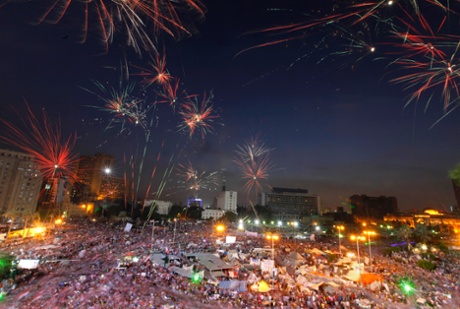
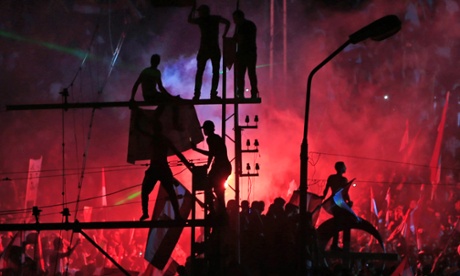
Sisi's televised statement was met by rapturous applause and a spectacular fireworks display at the centre of the anti-Morsi revolt in Cairo's Tahrir Square. The streets of downtown Cairo became a raucous carnival that lasted into the small hours, with many waving flags, blasting horns, and dancing. One or two could be seen drinking in the same streets that four days ago were jammed with frustrated drivers queuing for hours for petrol.
But five miles in east Cairo, the mood could not have differed more. A rally of Morsi supporters booed Sisi's speech, chanting "Down with military rule" – in scenes that epitomised Egypt's divisions. While secular Egyptians blame Morsi for autocratic policies that have failed to build consensus, Islamists are furious that Egypt's first democratically elected president should have been deposed after just a year in office.
Sisi's statement came several hours after his ultimatum for Morsi to solve the political crisis had passed without agreement. The delay confused all parties, who wondered whether a coup would actually take place. But the creeping presence of the military who set up barricades in parts of the capital where pro-Morsi supporters had gathered, followed by the release of a strongly-worded statement by Morsi's national security adviser, Essam Haddad, seemed to confirm to both camps that the military was taking a new role in post-revolutionary Egypt. "For the sake of Egypt and for historical accuracy, let's call what is happening by its real name: military coup," said Haddad.
The momentous events capped a harrowing week for Morsi and his key support base, the Muslim Brotherhood, which had won the presidency in a democratic election held a year ago. Morsi's support had been steadily whittled away over the past four days, first being abandoned by the military, then the powerful police force, and yesterday the state media.
 Earlier
in the week, police failed to intervene after the headquarters of the
Muslim Brotherhood in east Cairo was besieged for 12 hours and later
burnt down. Yesterday, the interior ministry, which runs the police
force, confirmed it was backing the military.
Earlier
in the week, police failed to intervene after the headquarters of the
Muslim Brotherhood in east Cairo was besieged for 12 hours and later
burnt down. Yesterday, the interior ministry, which runs the police
force, confirmed it was backing the military.While many on the street saw Morsi's removal as the continuation of Egypt's 2011 revolution, the ex-president's Islamist allies viewed it as a coup, and a betrayal of democracy. Thousands of Morsi supporters gathered in the streets to back him, many fearing that his departure would mark a return to the repressive treatment of Islamists under Mubarak.
Last night, the army shut down five Islamist TV channels, while there was factional fighting in Alexandria. State media said last night that three people had been killed in Alexandria. Police also raided the offices of the pan-Arab TV network al-Jazeera in Cairo.

0 comments:
Post a Comment